
Just north of the CBD, the Msasani Peninsula is Dar es Salaam’s premier residential address, home to diplomats and embassy staff, corporate expats on employer-sponsored packages, and senior government and political figures drawn to its exclusivity and connectivity. According to Knight Frank’s The Africa Report (2026/27), a standard luxurious apartment in the peninsula could fetch up to USD 4000 per month.
Looking at the average local rent market rates, a comparison for a premium two-bedroom house in five major cities in Eastern Africa shows that Dar es Salaam Peninsula sits at the top of that list.
City
Prime Residential Areas
Estimated Monthly Rent (USD)
Annual Equivalent
Masaki, Oyster Bay
$2,000–$3,500
$24,000–$42,000
Karen, Runda, Gigiri
$900–$2,000
$10,800–$24,000
Kololo, Nakasero
$1,500–$2,500
$18,000–$30,000
Nyarutarama, Kiyovu
$1,000–$2,000
$12,000–$24,000
Kabulonga, Leopards Hill
$1,000–$2,000
$12,000–$24,000
Africa Insight Advisors has conducted four iterations of the Dar es Salaam Peninsula Construction survey to showcase the growth story shaping up across the country. At any point from January 2023 to August 2026, there appear to be more than 100 ongoing construction projects in the Peninsula area (~11 square Kilometres).
Based on the latest data collected, a multi-layered story unfolds:
Africa Insight Advisors has conducted four iterations of the Dar es Salaam Peninsula Construction survey to showcase the growth story shaping up across the country. At any point from January 2023 to August 2026, there appear to be more than 100 ongoing construction projects in the Peninsula area (~11 square Kilometres).
Based on the latest data collected, a multi-layered story unfolds:
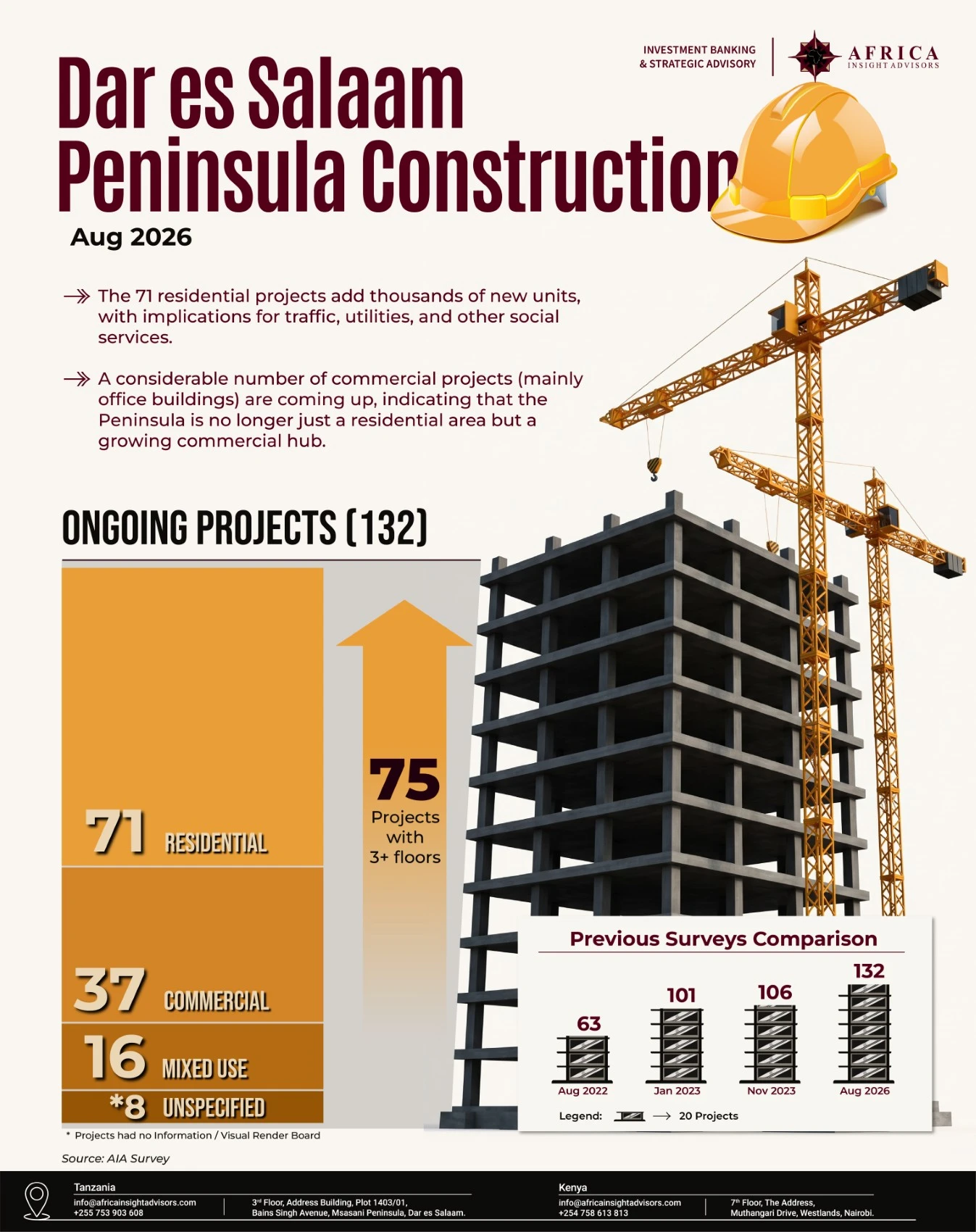
1. The construction pipeline is predominantly residential
The 53% residential share indicates that the construction activity in the peninsula is being driven primarily by demand for accommodation rather than by standalone commercial real estate. This is consistent with Tanzania’s urbanisation dynamics. The World Bank has previously identified urbanisation as a major source of economic opportunity and pressure on housing, infrastructure and urban services. (World Bank)
Commercial projects represent 37 projects, or 27.6% of the sample. This points to continued investment in retail, offices, hospitality, private services, institutional/commercial premises, warehouses, and other business-related structures.
The Peninsula is increasingly becoming a commercial hub with service-provider companies relocating to the area. The majority of the prominent Audit, Finance, Law, and other professional services firms already have their offices in the Peninsula.
2. Developers are betting on the mid-rise construction segment
75 projects have three or more floors, reflecting land economics and a substantial mid-rise development market. Among the 109 projects with known floor counts, the average is about 4.5 floors. The same trend can also be observed in the CBD and surrounding areas where developers and individuals purchase old conventional houses, demolish them and build high-rise buildings.
This trend has several possible implications:
Developers
- Mid-rise buildings can provide significantly more saleable or leasable floor area without the much higher capital expenditure and technical complexity associated with very tall buildings.
- Multi-storey construction is particularly exposed to fluctuations in prices of cement and other building materials. A good example is the rise in cement prices from TSH ~17,000 in April 2026 to TSH ~26,000 in August 2026, mainly due to a clinker shortage. This is especially relevant for buildings above approximately four floors because technical specifications become more demanding and the proportion of imported equipment can increase.
- The data suggests that demand is sufficiently broad to support continued development, but project economics should increasingly favour efficient land utilisation and carefully designed multi-unit schemes.
Construction Material Suppliers
- The combination of 75 projects with three or more floors and 26 multi-building projects implies substantial demand for structural and finishing materials. This opens up the building materials and equipment rental opportunity. The data suggests sustained demand for cement, steel, aggregates, and scaffolding/lifting equipment.
- The 4.5 average floor count across projects suggests demand is broad-based across many smaller contractors, not concentrated in a handful of large buyers. For a construction-materials manufacturer or distributor, the survey supports a relatively positive market thesis.
Financiers
- For financiers, the data indicates a sizeable pipeline but also highlights the need to distinguish between projects at different development stages and assess the developers’ ability to complete them.
- Also, ticket sizes are likely moderate, not large. With only ~7.5% of projects at 10+ floors and the bulk clustering at 3–8 floors, most construction financing needs here are probably mid-sized and shorter-duration rather than the capital-intensive, long-horizon financing high-rises typically require. That’s a lower-risk, more liquid lending profile for a financier building a portfolio.
- The legal floor limit for building construction in the Dar es Salaam peninsula generally ranges from 1 to 5 storeys for standard residential and low-rise zones, but can reach 6 to 14 storeys or higher in designated commercial and mixed-use zones based on plot size and specific municipal approvals under the Urban Planning Space Standards Regulations.
Investors
- For investors, the strongest opportunities are likely in businesses serving the construction ecosystem rather than investing directly in individual buildings, for example, construction logistics, insurance, specialist contracting, project management and property-development platforms.
- 36% of residential projects are multi-building developments that will likely need shared infrastructure once built. Aspects like estate management, private security, shared power/water solutions (generators, boreholes, solar), and possibly facilities/property management services for multi-building residential compounds typically generate recurring revenue that single houses don’t.
Policymakers
- For policymakers, the survey reinforces the need for urban planning, well-maintained facilities (roads, drainage, water, electricity, and sewerage) infrastructure, and public transport to keep pace with increasing development density. More multi-storey and multi-building development means substantially greater pressure on the existing urban infrastructure.
Are you interested in the East African investment landscape? Let’s have a chat today.
For more updates on what we do, connect with us on LinkedIn.